
Badlands
Martin Sheen
Sissy Spacek
Terrence Malick
94 mins.
Crime, Drama
October 15, 1973
PG
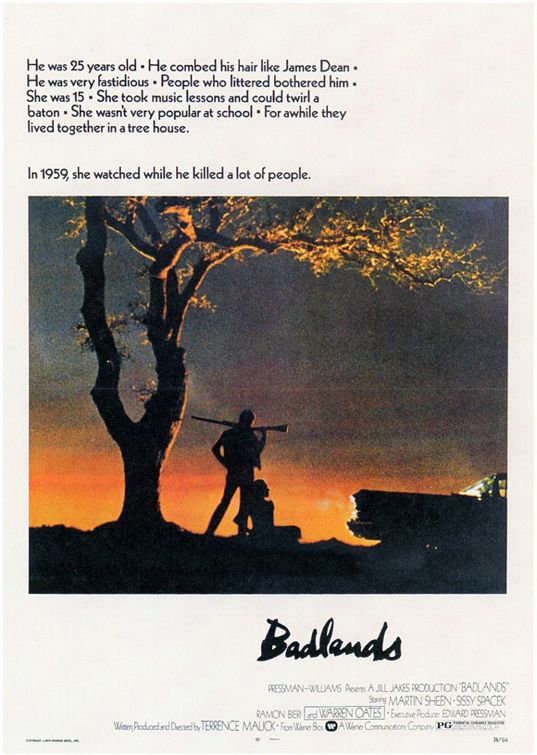
“Badlands” (1973), set in the 1950s, is Terrence Malick’s first directorial feature film. He also wrote and produced it. It’s about Holly, a teen girl played by Sissy Spacek, who lives in South Dakota. She’s the narrator. Holly meets Kit, played by Martin Sheen, who’s up to no good. Of course, Kit quickly casts his spell on Holly. Also, Kit’s a decade older than Holly, but, mentally, they’re the same: detached from reality and behaving in ways that only they would think is appropriate. These two have no idea of what they’re doing. They act first, according to impulse, and deal with the aftermath as if it’s no big deal.
Kit’s first murder (yes, murder) is of Holly’s father, who won’t allow Kit to take Holly away. Kit seems to want to live up to the stereotype of a celebrity criminal. As he commits more murders, he embraces this role more and more. When he’s captured (after Holly gives up on running away with him and turns herself in), he talks to the police officers as if nothing major happened. He’s mostly concerned about how he will be perceived, but concerned in a jovial way. Even the officers have bemused smiles as they converse with him. Holly says she simply did whatever he said to do, because she “loves” him. At the end, she reports to the viewer that she goes on to receive dirty looks from people and to marry the son of her lawyer.
“Badlands” is Malick’s comment on youth and celebrity. It’s interesting, because, while it was made in 1973, these comments are still being made in today’s films. People love to pretend that celebrity culture is a new phenomenon, but this film reminds us that it’s not (“Bonnie & Clyde” serves a similar purpose). Things may seem different, but they’re really the same.
The style of this film reflects the childish, thoughtless actions of its leads. None of the murders has the weight that it deserves. This makes sense because Holly is the narrator. Her style of speech is akin to how she would speak in front of a class if she had to read a book report. Similarly, the music, at times, seems to mimic a child’s wind-up toy. All of this lends the film a quality similar to that of a bedtime story; Malick himself likened it to a fairy tale. That’s the horror of it, but it would be easy to ignore that if you’re not paying attention.
This is definitely a “first” film, but I understand why critics were excited about Malick after seeing it. His style is very clean and straightforward here; it’s completely different from what he does now (“The Tree of Life,” “To the Wonder”). He doesn’t waste a second in this film. He shows just enough, and what he doesn’t show matters as much as what he does show. He uses the actors, as always, to convey a particular mood. They do a great job of that.
You can see how Malick has grown from this film to his latest, “To the Wonder,” stylistically: from this to “Days of Heaven” to “The Thin Red Line” to “The New World” to “The Tree of Life” then to “To the Wonder.” What a transformation he’s undertaken as a director.
“Badlands” is a fine first feature. It shows promise, but Malick doesn’t nail it. The ideas matter more than the film itself, I think.
Verdict: OK to Somewhat Good
About: (Source: criterion.com/badlands)
Badlands announced the arrival of a major talent: Terrence Malick. His impressionistic take on the notorious Charles Starkweather killing spree of the late 1950s uses a serial-killer narrative as a springboard for an oblique teenage romance, lovingly and idiosyncratically enacted by Martin Sheen and Sissy Spacek. The film introduced many of the elements that would earn Malick his passionate following: the enigmatic approach to narrative and character, the unusual use of voice-over, the juxtaposition of human violence with natural beauty, the poetic investigation of American dreams and nightmares. This debut has spawned countless imitations, but none have equaled its strange sublimity.


