
Force Majeure
Johannes Bah Kuhnke
Lisa Loven Kongsli
Clara Wettergre
Vincent Wettergren
Kristofer Hivju
Fanni Metelius
Ruben Östlund
120 mins.
Comedy, Drama, Foreign
December 30, 2014
Rated R for some language and brief nudity. (MPAA)
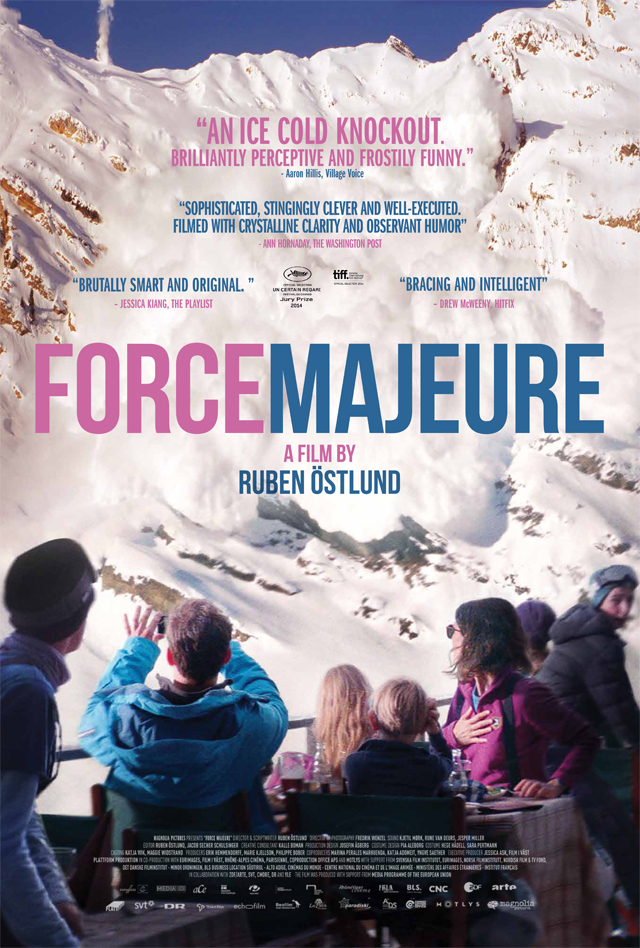
“Force Majeure,” both a drama and a bleak (very bleak) comedy, surprised me – but not because of its plot. I was surprised by how it used one event in one family’s life as the starting point for a larger exploration of identity and relationships. The title’s literal translation is superior force, and its use as a legal term is in reference to acts of God. This film’s description is provocative in and of itself: As an avalanche approaches a restaurant at a French ski resort, a father flees to safety, abandoning his wife and children in the process. But that’s what this film is about on its surface; it goes much deeper than that. It’s really about the tension between the individual and the family, between taking care of oneself and taking care of others, between how you perceive yourself and how others perceive you, and between who you think you are and who you actually turn out to be. They also explore gender roles and the expectations that come with them. And they certainly explore contemporary notions on male heroism and male cowardice, but not in a black and white sort of way.
The avalanche doesn’t just affect the husband, wife, and their children; it also affects the people they spend time with during their vacation: The wife launches into an attack on her friend who’s married but sleeps around with other men. She also tells that friend and one of her friend’s dates about the avalanche incident. The husband doesn’t agree with her interpretation, but he’s wrong. We know that, because we saw it. Later on, she tells his friend and his friend’s new girlfriend the same story. The husband disagrees once more, so she settles it by forcing everyone to watch what happened via a video on her husband’s phone: He was filming the avalanche before he decided to run away. This leads to a conversation between the husband’s friend and the husband’s friend’s girlfriend that becomes much more than they intended it to be: The girlfriend questions her boyfriend’s manhood in a recklessly hypothetical fashion.
It’s as if the avalanche isn’t just physical; it has a mental and emotional affect – that’s where it does its damage. This is highlighted by shifts between scenes with dialogue and without dialogue. I found many of the scenes without dialogue more powerful. Many of those scenes are sprinkled with bits of the “Summer Concerto” from Vivaldi’s “The Four Seasons” – there’s a bit of irony.
The dialogue is good, though, and there’s just enough of it. The conversations go from awkward and subdued to direct and explosive. There’s tension beneath the surface, but not in an oppressive fashion. You don’t feel an existential dread; you feel and everyday sort of weariness, a weariness that builds day after day and year after year. The avalanche is simply a catalyst for of all of those unspoken frustrations and doubts to surface.
The backdrop provides a perfect contrast to the subject matter. The mountains of white snow look coldly dispassionate yet beautiful at the same time. Similarly, a male hotel employee watches dispassionately from the balcony above as the couple has conversations outside of their hotel room. The first time they notice him doing this, they ask him to give them some privacy. He doesn’t respond in any way.
At the end of the film, there’s some sort of redemption for the two principal male characters, but it rings hollow. I was left thinking about how pointless it seemed. I’m sure that this is the filmmaker’s intention. Long-standing conventions have been rendered useless in Western society, at least that’s the message I received. You don’t have to agree with that – it’s the thought that counts. While this film won’t blow you away, it will make you think long after it’s over. They won’t be comfortable thoughts. The simplicity of “Force Majeure” is its strength.
Verdict: Very Good
About: (Source: forcemajeure)
This wickedly funny and precisely observed psychodrama tells the story of a model Swedish family—handsome businessman Tomas, his willowy wife Ebba and their two blond children—on a skiing holiday in the French Alps. The sun is shining and the slopes are spectacular but during a lunch at a mountainside restaurant, an avalanche suddenly bears down on the happy diners. With people fleeing in all directions and his wife and children in a state of panic, Tomas makes a decision that will shake his marriage to its core and leave him struggling to reclaim his role as family patriarch.

