
American Hustle
Christian Bale
Bradley Cooper
Jeremy Renner
Amy Adams
Jennifer Lawrence
Louis C.K.
Jack Huston
Michael Peña
Shea Whigham
Alessandro Nivola
Elisabeth Röhm
Paul Herman
Eric Warren Singer
David O. Russell
138 mins.
Crime, Drama
December 20, 2013
Rated R for pervasive language, some sexual content and brief violence. (MPAA)
David O. Russell’s films tend to be overrated, in my opinion, especially “Silver Linings Playbook” and “The Fighter.” But those films are still very good, just not great. However, “American Hustle,” while not bad, isn’t that good. It does have good moments: Amy Adams rejecting Christian Bale for the first time during the first half of the film; Robert De Niro’s scene, major stakes in that one; Bale revealing the error of Bradley Cooper’s ways toward the end. And it’s definitely not boring. But it’s largely uneven and disjointed. The supposedly comedic moments seem to be there just to elicit laughter, not to serve the story. This isn’t a successful comedy: It just isn’t funny enough, in my opinion. It isn’t even funny enough to be a successful dramedy (again, in my opinion, thanks).
One major problem is that this film is similar to two of Scorsese’s finest, “Goodfellas” and “Casino.” The flaws of this film really show if you’ve already seen those Scorsese films. The camerawork is similar, at times, but Scorsese uses his camera to make you feel like you’re on the inside. Russell doesn’t do that at all; I always feel like I’m on the outside looking in during a Russell film. Unlike “Goodfellas” and “Casino,” “American Hustle” doesn’t invite the audience into its characters’ world. We’re not introduced to its world in a clear and compelling fashion; we’re simply thrust into it with little explanation. We just have to make sense of things as we go along. Look, I’m fine with revelations, but they have to be worth it. That’s not the case here.
Furthermore, a lot of the scenes are stagnant, particularly the scenes between Jennifer Lawrence and Christian Bale. Most of the improvisations just last too long. They’re redundant, as a result. This hinders the buildup of momentum that this story needs. What happened to the stakes? What happened to the momentum? They’re constantly undercut by a lack of narrative focus and editing. (Is this a con film or a mob film? The combination of the two don’t work. Is this “The Sting” or “Goodfellas”? You can’t have it both ways … well, at least Russell can’t.)
Lawrence seems to be out of her depth with this character. It’s a surprisingly one-note performance. She doesn’t do a terrible job, but where’s the nuance? In contrast, Amy Adams is superb. She brings a lot to her character; there are many layers to her performance, and she doesn’t force anything. At first, I thought that the major difference between Lawrence’s and Adam’s performances was the script. On the surface, it seems that Adams’ character gives her more to play. But upon further reflection, the real difference is that Adams mines her character for a range of emotions, thoughts, and feelings. Lawrence leans too heavily on the broad stupidity of her character and not on what really drives her character. Is she just a stupid woman or is she conveniently stupid? I hope that it’s the latter, but Lawrence does nothing to support that hope. Maybe Lawrence is just too young to be able to nail this kind of character. Throughout the film, I never fully buy that Bale would be so easily conned by her.
Speaking of Bale, he does a fine job, especially in the second half of the film. I can’t say the same for Cooper. He’s OK, I guess. He does nothing revelatory or interesting outside of his imitation of Louis C. K. As for Jeremy Renner, he is wasted. His scene with Bale, at the end of the film, is one of its highlights, though.
So, it’s Adams who has the breakout performance, and Bale is second in line. The two of them together should have been the primary focus of this film.
In the future, I hope that Russell will focus on presenting a leaner and meaner vision. Instead of aping Scorsese and failing, learn something from him: You can’t stretch a simple story into a two-hour film. “Goodfellas” and “Casino” span decades of time. They earn their length. In contrast, “American Hustle” should have swept in and out.
Despite its flaws, whenever music and narration are present in “American Hustle,” it finds its rhythm. But once they leave, most of the scenes just go on too long. Plus, the ending is way too easy. None of the central characters experience major consequences. This is another difference between this film and “Goodfellas” and “Casino.” In regards to that ending: Would a mob guy date a woman (Lawrence) who snitched, to him, on her husband (at the time) seemingly by mistake? Would he then trust that information enough to use it for his and for the mob’s advantage? How could he trust that woman at all? Ugh. Just find a good editor for the next one, or make sure that you yell “cut” a little sooner.
Verdict: Somewhat Good
About: (Source: americanhustle-movie.com)
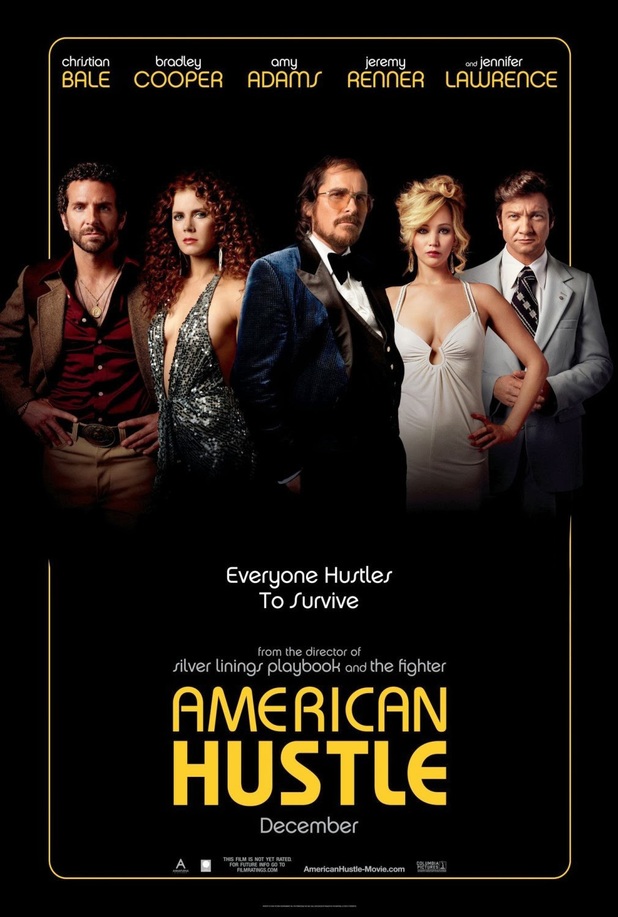
A fictional film set in the alluring world of one of the most stunning scandals to rock our nation, American Hustle tells the story of brilliant con man Irving Rosenfeld (Christian Bale), who along with his equally cunning and seductive British partner Sydney Prosser (Amy Adams) is forced to work for a wild FBI agent Richie DiMaso (Bradley Cooper). DiMaso pushes them into a world of Jersey powerbrokers and mafia that’s as dangerous as it is enchanting. Jeremy Renner is Carmine Polito, the passionate, volatile, New Jersey political operator caught between the con-artists and Feds. Irving’s unpredictable wife Rosalyn (Jennifer Lawrence) could be the one to pull the thread that brings the entire world crashing down. Like David O. Russell’s previous films, American Hustle defies genre, hinging on raw emotion, and life and death stakes.


