
August: Osage County
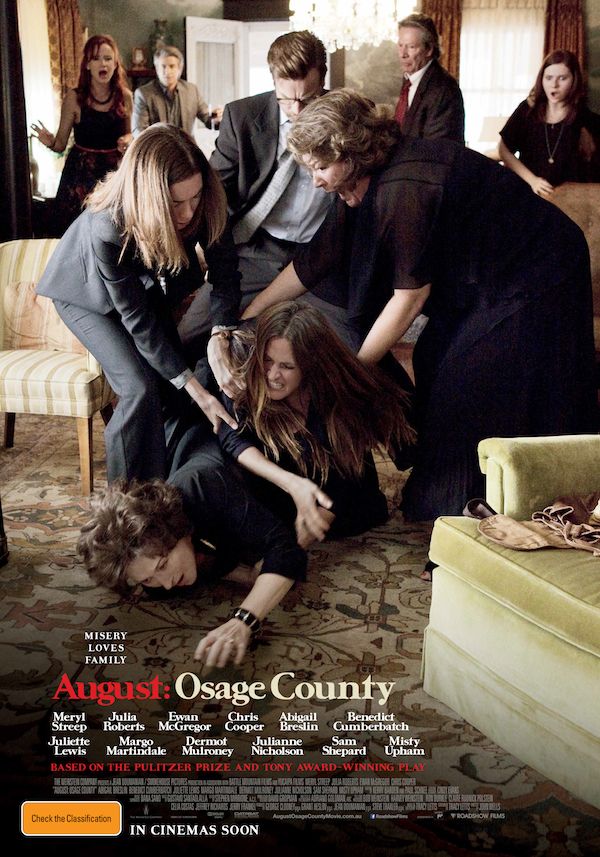
Meryl Streep
Julia Roberts
Ewan McGregor
Chris Cooper
Abigail Breslin
Benedict Cumberbatch
Juliette Lewis
Margo Martindale
Dermot Mulroney
Julianne Nicholson
Sam Shepard
Misty Upham
Tracy Letts
121 mins.
Drama
January 10, 2014
Rated R for language including sexual references, and for drug material. (MPAA)
First of all, the film version of “August: Osage County” is not the play, and it’s not an attempt at subtle filmmaking. If you have fond memories of the play and find it hard to put those memories aside, then don’t see this. This is the film version, and it should be judged as a film. Also, if you think that all film acting should be underplayed, then don’t see this. Realism doesn’t necessarily mean subtlety. There are lots of over-the-top, colorful characters in the real world (take that “realism” nuts); I know some of them. An over-the-top performance, supported by the script, can be extremely entertaining and satisfying when it’s grounded in honesty. One purpose of art is catharsis. Sometimes, characters need to do things that we wish we could do; we can live vicariously through the characters, instead of going crazy ourselves (even though some people still do).
With that said: I really enjoyed watching this film, even with its imperfections: This isn’t what I would call a “well-made” film. At the beginning I thought, “I hope this doesn’t turn out to be another film of a play that doesn’t quite escape its stage origins.” But once all of the family members started to arrive, I was quickly disabused of that thought. The casting is superb, and the screenplay is well-tailored to film. As I watched this, I understood why so many people loved the play. I could imagine what the theatrical experience must have been like. This felt like a real family with a history, even before the film reveals what some of that history is. While you wouldn’t want to be a part of this family, there are families just like this out there in the world. Plus, the filmmakers ensured that the Oklahoman landscape was well represented. The shots of that landscape served as a reminder not only of the family history at play, but also of this family’s patterns and pathologies (as Iyanla would say) that are connected to that history.
Meryl Streep proves, yet again, that she’s a force of nature. This is the first time that I thought about Streep’s stage acting experience while watching her on film; I didn’t think of that during “Doubt,” for instance. She pulls out all of the stops both physically and vocally. Yes, she uses a lot of ticks; but those ticks aren’t her acting destination. Instead, she uses the ticks to get to the heart of her character. The ticks help her to get the story across. She had a great, unpredictable, unhinged character to play; and she milks every moment. But there are quiet moments from her, as well. Actually, I think that her portrayal of this character provided every reaction possible from a human. I never knew what she was going to do or say next; this defines “high-wire act.” I’m a sucker for this kind of performance when it’s done well. This rivals Streep’s performance as Miranda Priestley in “The Devil Wears Prada,” but these two characters couldn’t be any more different. One problem with this kind of character and performance is that there seems to be a void left when the character isn’t onscreen. In the case of this film, that void was still filled with really good moments, though not as great or as entertaining.
As for the rest of the cast, the women shine more than the men do. The men serve their purposes, but this isn’t really their story. (Chris Cooper’s interpretation of one of the most awkward and hilarious graces during the repast is a stand-out, though. Streep’s reaction throughout is priceless). Margo Martindale is reliably wonderful as Streep’s sister, and the trio of Streep’s daughters (played by Julia Roberts, Julianne Nicholson, and Juliette Lewis) complement each other well. As for Roberts in particular, she has the toughest character to play as the principle challenger to Streep’s onslaught of abuses. This is a role that is atypical for Roberts, and she shows that she’s not an actress to be taken lightly. She sticks with Streep all of the way, even if she cannot quite match her. I was happy to see her in this role, even when she didn’t always completely land the moment; that’s being nitpicky, though. I remain a big fan of hers. I hope that she’ll win over new fans with this performance. She’s at her best when she’s listening in this film. That’s a compliment. She really listens instead of acting like she’s listening; and she listened with a point-of-view.
Now, there are some other flaws in addition to the “Streep” void. The biggest one was the positioning of the climax. The extended scene at the dining room table was the definite climax here. But there was a little too much falling action afterward. I don’t know how this was handled in the play, but I felt a bit of a letdown after that scene; this was not a major problem, though.
Overall, “August: Osage County” is a roller-coaster ride of a film with beat changes galore. Luckily, Tracy Letts’ well-adapted screenplay was in the hands of actors who could make most of those beat changes sing. And director John Wells had the good sense to stay out of the way and allow room for imperfection. Just give in to this film, and you’ll likely be overwhelmed. This film’s trailer doesn’t do it justice. You’ll definitely laugh, but you just might feel a bit of a cry coming on, too.
Verdict: Very, Very Good
About: (Source: augustosagecountyfilm.com)
AUGUST: OSAGE COUNTY tells the dark, hilarious and deeply touching story of the strong-willed women of the Weston family, whose lives have diverged until a family crisis brings them back to the Midwest house they grew up in, and to the dysfunctional woman who raised them. Letts’ play made its Broadway debut in December 2007 after premiering at Chicago’s legendary Steppenwolf Theatre earlier that year. It continued with a successful international run.


