
American Sniper
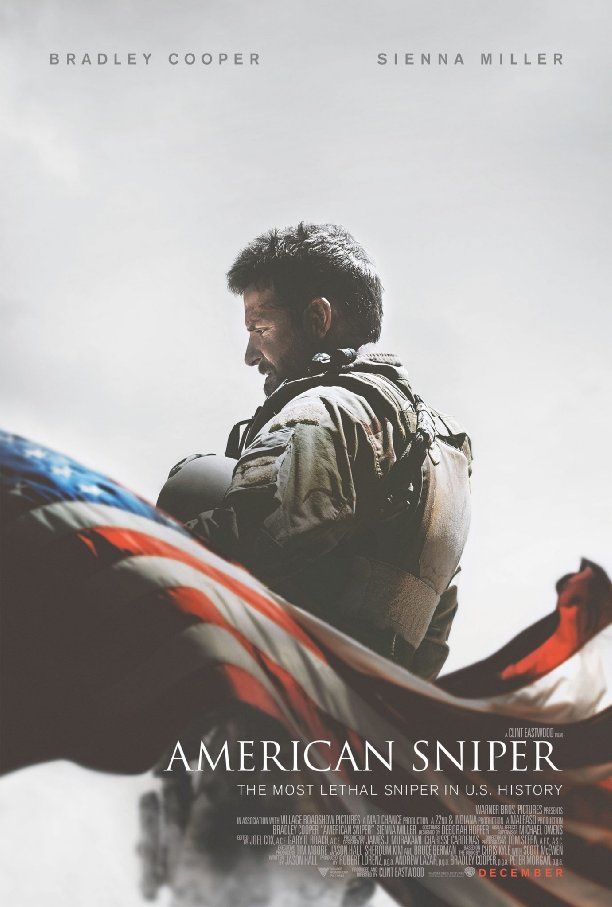
Bradley Cooper
Sienna Miller
Jason Hall
133 mins.
Action, Biography, Drama
December 25, 2014
Rated R for strong and disturbing war violence, and language throughout including some sexual references. (MPAA)
Clint Eastwood’s “American Sniper” begins by showing Chris Kyle, well-played with clean acting by a beefed-up Bradley Cooper, preparing to shoot his targets in Iraq: a mother and her son who have a bomb in their grasp. Then, the film cuts to telling Kyle’s backstory. It reminded me of a shortened version of Superman’s backstory on Earth, but with western overtones and without the superpowers, of course. It was typical biopic stuff.
After that, we come back to the mother and son: Kyle shoots them before they can get close enough to his fellow soldiers to do any damage with the bomb. But by the time we get there, the depth, the weight, the power of that moment is lost. Actually, the whole film seems a bit lightweight, surprisingly.
Eastwood has crafted a film, based on Kyle’s autobiography of the same name, that has rhythm and brisk pacing overall – where was that in “Jersey Boys,” Eastwood’s film adaptation of the Broadway musical? It’s a collection of snapshots from Kyle’s life. But those snapshots are this film’s strength and its weakness. They keep things moving, but to what end?
This film has a largely Manichean view of war. Kyle’s father tells him that there are three kinds of people: sheep, wolves, and sheep dogs. He forgot wolves in sheep’s clothing. Kyle and his fellow soldiers are sheep dogs: They protect the sheep. While that may be true, the only sheep I could locate in the film were a few of the Iraqis (the first family of informants who meet a tragic end), Kyle’s wife and children (I guess), and his brother, who grew to hate “this place” (Iraq) after he followed in his older brother’s footsteps by enlisting. The wolves are the terrorists, obviously. Those wolves include women and children. All of the Iraqis come across as props, instead of people, in my opinion. At the end, there’s a wolf in sheep’s clothing: a troubled veteran who Kyle tries to help.
However, by the time we get to the end of the film, there isn’t much to takeaway from it. Many of the questions and ambiguities proposed earlier on have been quickly discarded. There are flashes of ideas beneath the surface that are hinted at by a few of Kyle’s fellow soldiers: a soldier who went to seminary school and questions Kyle’s motivations, and another soldier who tells Kyle that Kyle doesn’t have to go back for his fourth tour in order to make the enemy pay for shooting the soldier in the face, for instance. But those ideas don’t go beyond the shallow end of the pool. Either develop them or leave them out completely. Don’t half-step. This film tasks the viewer with adding depth to the story via their own experiences.
The one lasting impression is Kyle’s apparent PTSD, which leads him to mentor his fellow vets. It’s nothing new, though. (Nothing here is.) Eastwood chooses not to show us how Kyle was killed, instead he tells us after foreshadowing that moment via Kyle’s wife, played by Sienna Miller. I thought that that ending was a bit of a cop-out. Plus, Miller’s wife comes across as petulant and lacking in understanding, so giving her the ending moment seemed off. This wasn’t Miller’s fault, though.
Despite that, the ending might have worked if Eastwood and screenwriter Jason Hall had edited 20 minutes out of the film. Then those snapshots could have led to a crescendo that culminates on an ironic and tragic note: Kyle finally finds a way to be there for his family instead of just for his country, only to be killed when he lets his guard down. Or, Eastwood could have chosen some spots to let the moments land. Let the audience think a little.
As it is, “American Sniper” is a mostly well-made film (fake babies notwithstanding, what was that about?) with great sound (the crunch of a tank moving over rocks, the pop of bullet being shot, the clunk of a shot glass hitting a table) and a strong central performance. It will likely reaffirm many Americans’ belief in their country. But why this story? What does it have to say that we haven’t heard before? Is it simply a way to honor the deadliest sniper in American history without mucking things up with politics or inquisitiveness? Without delving into the fog of war? Is that all?
Verdict: Good
About: (Source: americansnipermovie)


