
Leviathan (2013)
Lucien Castaing-Taylor
Verena Paravel
87 mins.
Documentary
March 1, 2013
Not Rated
“Leviathan,” which had a limited release in U.S. movie theaters in 2013, is a documentary about the activities on a commercial fishing boat, which must be what’s symbolized by the title. That boat must be represented by that titular biblical sea monster.
Lucien Castaing-Taylor and Véréna Paravel share the directing duties, and they provide no interviews and no narration during this documentary’s runtime. We can hear the crew speaking among themselves every now and then, but what they have to say isn’t made entirely clear to us. Their talking is just another one of the sounds that can be heard in this environment, and those sounds are one of this film’s highlights.
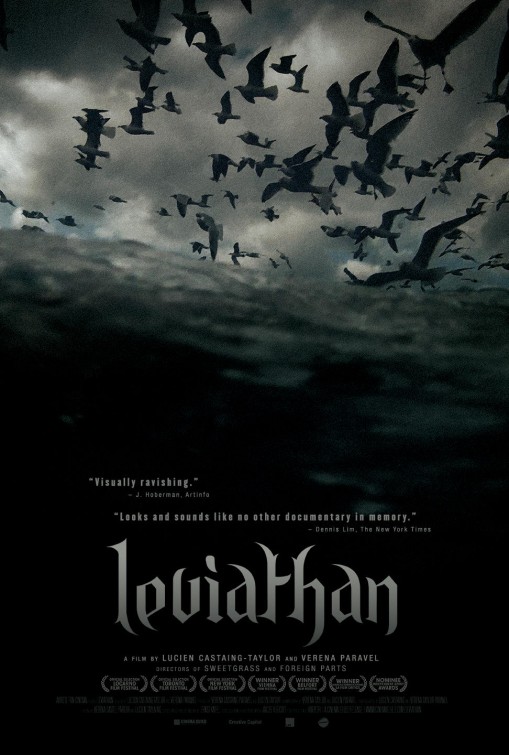
The camerawork is full of extreme close-ups of the crew, the fish and other sea creatures both on the boat and in the water, and the machinery of the boat. The camera will linger on one of its subjects, then jump to a different, unrelated subject. One of the best series of images is of a bird that cannot fly off the boat. We see its struggle to find a way out to no avail. It eventually dives off the boat and into the water, but we don’t see what happens to it after that (I assume that it drowned). The section that focuses on the flock of seagulls in flight is another highlight.
Those sights and sounds blend together to give the viewer an insider’s look at the commercial fishing business. We see and hear the damage, the intensity, and the violence. Along with the bodies of fish and other sea creatures, we see their carcasses, blood, and guts sloshing around and sometimes off the boat. This isn’t pretty stuff.
While “Leviathan” throws the boat’s clash with nature in its audience’s face, it’s a bit too repetitive and narrowly focused to warrant a feature. This kind of work has been chronicled on numerous TV shows, including “Dirty Jobs” (in this film, one of the crew members actually watches that show on the boat), “Anthony Bourdain: No Reservations,” and “Undercover Boss.” So why do we need to watch this film?
The message is clear, but it’s not as affecting as it could’ve been. The impersonal nature of the film both helps and hurts. (Frederick Wiseman, director of “La Danse: Le Ballet de l’Opera de Paris” and “At Berkley,” is a master of this kind of documentary filmmaking. I wonder how he would have told this story.)
Many critics loved this, but most people won’t be interested enough to care.
Verdict: Whatever to OK
About: (Source: leviathan)
in the very waters where melville’s pequod gave chase to moby dick, leviathan captures the collaborative clash of man, nature, and machine. shot on a dozen cameras — tossed and tethered, passed from fisherman to filmmaker — it is a cosmic portrait of one of mankind’s oldest endeavors.


