
The Bastard Executioner
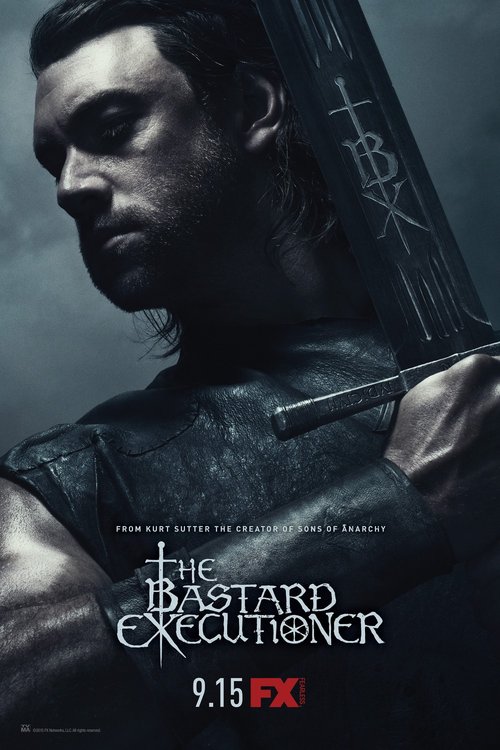
Lee Jones
Katey Sagal
Flora Spencer-Longhurst
Sam Spruell
Sarah Sweeney
Danny Sapani
Kurt Sutter
Stephen Moyer
Created by:
Kurt Sutter
2015-
Drama, History
FX
TV-MA
At the beginning of “The Bastard Executioner,” Kurt Sutter’s new FX drama, this flashes onscreen: “Fearing rebellion, English barons rule their fiefdoms with uncompromising brutality.” Translation: Things ain’t good. Shortly thereafter, we witness the dream (or nightmare) of Wilkin Brattle (Lee Jones). Flashing back to five years before, Brattle, a Welsh knight at the time, was in a battle that didn’t end well. He’s been haunted by that battle ever since. In his dream, he relives the slaughter of his fellow men. He also hears the voice of and sees what seems to be a messenger from God. (He’s Catholic, after all.) This little-girl messenger says, “Your savior needs you.” In addition, he has a vision of some sort of dragon-like creature. Who knows why? It sure is an ugly little thing. As a result of this experience, Brattle puts his warrior sword down only to eventually pick up the sword of an executioner instead.
If that sounds interesting to you, wait until you watch the show. It’s … bland. During its two-hour opening episode, the first half is largely exposition. We meet Brattle’s wife and fellow farmers. Yes, he’s a farmer now … supposedly. We also meet the baron who owns the land that he lives on. The baron’s connection to the aforementioned battle is revealed later on. Baron Ventris (Brían F. O’Byrne) suffers no fools when it comes to his money and property. His stone-faced adviser, Milus Corbett (Stephen Moyer), is the kind of adviser you’d think that Ventris would have. But this introduction doesn’t have a hook. Actually, it’s hard to pay attention to what everyone’s saying and doing because they don’t make you care. (This isn’t uncommon for a Kurt Sutter show. “Sons of Anarchy” had similar problems … in my opinion.) Why am I watching this, again? “The Bastard Executioner” doesn’t provide a clear answer.
(But what about the second half of this two-hour series opener? Do things improve then? … Nope, not really.)
Set in 14th-century Wales, the entire look of this show is predictable and derivative. When it’s preoccupied with Brattle’s battle-vision sequence, “The Bastard Executioner” looks like Starz’s “Spartacus.” It’s clear and colorful. The blood is a vibrant red. However, at other times, especially during its interior scenes, it looks more like “The Pillars of the Earth” or “Vikings.” It’s a shaded look. You can guess what the sets, wigs, and costumes look like. Many of the characters have dirty teeth, too. Nice touch. They even show us the soiled cloth that the baron’s servant used to wipe the baron’s bum after the baron … well, you know. How lovely.
While “The Bastard Executioner” is derivative, that’s not its major problem. Along with its lack of narrative force, it looks a wee bit artificial, and the effects (check out that aforementioned dragon thing) aren’t great. This doesn’t come close to the quality of “Game of Thrones.” Paris Barclay, the director of this show’s first three hours, does what he can to keep us distracted from its flaws. He uses hand-held cameras that move around rather restlessly at times. These cameras seem to be on the hunt for something: They zoom around during the exterior scenes. Another technique that Barclay uses is to fade to black-and-white just before each commercial break. I don’t know why. I guess that’s supposed to remind us that this is serious stuff. Regardless of its stylistic bells and whistles, this show’s production values just aren’t good enough to support the story it’s telling.
As for the acting, it’s passable. Stephen Moyer turns in one of the most interesting performances here, along with Katey Sagal, as some sort of soothsayer, whose thoughts seem to be far, far away. (Her accent must be from the same place.) But these actors can only do so much with this material, because it looks like the creative team is still trying to figure out what this show should be. The rhythms are off. However, the one thing they are sure of is that no character is safe. (Haven’t we seen this kind of thing before?) In the middle of the first two hours of “The Bastard Executioner,” the baron goes after Brattle’s and his fellow farmer’s wives and children. Brattle and his men spurred the baron’s response by attacking his tax collectors. As with much in this show, you can imagine how that goes down. It’s all very “Robin Hood.”
What “The Bastard Executioner” needs most is to gel … and fast. Right now, there’s nothing to sink your teeth into. It’s not a disaster, but it doesn’t grab your attention. I’ll give it one more episode.
Verdict: Whatever
About: (Source: executioner)
The Bastard Executioner is a blood-soaked, medieval epic that tells the story of Wilkin Brattle, a 14th century warrior, whose life is forever changed when a divine messenger beseeches him to lay down his sword and lead the life of another man: a journeyman executioner. Set in northern Wales during a time rife with rebellion and political upheaval, Wilkin must walk a tight rope between protecting his true identity while also serving a mysterious destiny.
Guided by Annora, a mystical healer whose seeming omniscience keeps Wilkin under her sway; manipulated by Milus Corbett, a devious Chamberlain with grand political aspirations; and driven by a deepening connection with the Baroness Lady Love, Wilkin struggles to navigate political, emotional and supernal pitfalls in his quest to understand his greater purpose.


